You walk into a gold buying shop holding a stamped, official appraisal for a $5,000 diamond ring.
You expect a matching check, but the buyer offers you a tiny fraction of that amount. Your stomach drops, your anger flares, and you assume the person behind the counter is trying to rob you blind.
Take a deep breath, because you’re probably not getting ripped off.
The frustrating truth is that you have been misled by the structural purpose of the document in your hand.
Can you sell jewelry for its appraised value?
No. A standard jewelry appraisal does not reflect liquidation or cash resale value.
Instead, it calculates Retail Replacement Value (RRV) for insurance companies. This number estimates what it would cost to recreate that exact item brand-new at a retail boutique, factoring in labor, marketing, retail markups, and overhead. On the secondary market, jewelry is valued by its raw commodity melt value, which is typically 5% to 30% of the original retail appraisal.
Understanding the gap between jewelry appraisal vs resale value is the first step to understanding what your jewelry is really worth.
The Great Illusion: Retail Replacement Value (RRV) vs. Melt Value
An insurance appraisal is an artificial financial metric designed for a very specific, corporate purpose.
When a certified gemologist writes a high dollar amount on your document, they are estimating the retail replacement value. This figure complies with industry standards used by insurers to determine what a retail boutique would charge to replace the item today.
It represents the absolute maximum cost to recreate your piece from scratch at a traditional jewelry store.
That massive retail price tag contains a massive amount of economic fluff that instantly evaporates on the secondary market.
You paid for…
- the boutique’s prime mall rent
- heavy security
- the sales agent’s fat commission check
- the materials
- the salaries of the craftsmen
- the marketing cost
- plus a premium for the business owner’s profit
Once the item leaves the store, that entire service-based cost structure disappears into thin air.
Why is jewelry resale value so low?
The answer lies in the psychological game of insurance appraisal inflation. Retail jewelers frequently inflate written appraisals by 20% to 50% above what you actually paid at the counter.
This artificial padding serves two distinct masters in the retail ecosystem.
- It makes you feel like you just scored an instant, incredible bargain on your purchase.
- It gives insurance companies a massive multi-year buffer against precious metals inflation while justifying higher monthly premiums.
Unless your document explicitly states “Fair Market Value” or “Liquidation Value,” it holds zero utility for raising cash, and even then most dealers would ignore the appraisal and go off of real time market data.
Just the other day, a client brought in an inherited family necklace with a faded $8,000 appraisal from a defunct retail chain.
She was counting on that money for a down payment, completely convinced of its cash validity. I had to gently explain that the $8,000 figure only existed as a theoretical insurance replacement value.
The actual cash value of the gold weight was closer to $1,500. It was a heartbreaking conversation, but it revealed how deeply the retail illusion distorts reality.
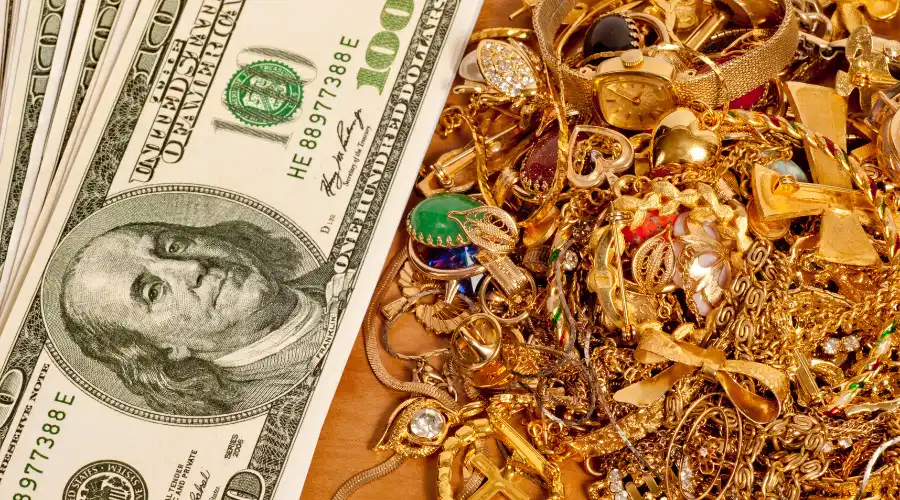
The Cold Mechanics of the Secondary Market: Why Everything is “Melt”
The secondhand market is driven by brutal, unfeeling economic laws rather than emotional sentimentality.
Just like driving a brand-new vehicle off the dealership lot, retail jewelry loses most of its value immediately. The secondary market has zero interest in paying for another business’s past marketing campaigns or expensive storefront rent.
Once a piece enters the secondary market, its past retail prestige is completely wiped clean.
The industry truth is that 95% of secondhand jewelry brought to gold buyers is never resold as-is. Consumer styles change rapidly, tastes evolve between generations, and everyday wear leaves a web of microscopic scratches. Second hand jewelry rarely ends up in another showroom display case to be sold to a new consumer.
Instead, it’s packed up and sent to a refinery to be melted back into their base metals to be remade into jewelry, technology, investment pieces, and more.
There, the jewelry is thrown into a high-temperature furnace and melted down into a liquid state. Refiners use chemical processing to split alloyed metals back into pure .999 fine gold, silver, platinum, or palladium.
The Math Behind Gold and Silver Offers
Calculating the melt value vs appraisal value requires simple, transparent mathematics instead of subjective opinions.
Honest dealers utilize a standardized industry formula to determine the exact raw value of your scrap gold melt price. You can track this math yourself to ensure you are getting a fair treatment.
Weight X Metal Purity X Current Spot Price = Theoretical Full Raw Material Value
This is the most simple formula to calculate the theoretical value of your jewelry. This is not the number you would be offered.
Let me repeat that, THIS IS NOT THE NUMBER YOU WOULD BE OFFERED.
A professional gold buyer cannot pay you 100% of this raw spot price if they want to stay in business.
- Rent isn’t free.
- Utilities aren’t free.
- Employees don’t work for free.
- Shipping isn’t free.
- Insurance isn’t free.
- In fact, refining isn’t free! So precious metal dealers aren’t earning the full precious metal value when they refine your sold scrap metal.
Also, once a precious metal dealer buys your item, they are now at the mercy of the market. Especially since most cities and states have regulations requiring precious metal dealers to hold on to any purchased items for a certain period of time, sometimes as little as 24 hours, sometimes as long as a mandatory 30 day hold. As often as we’ve made extra money from needing to hang on to items, we’ve lost just as much from needed to sell at a market low.
At the Gold Guys we offer some of the best deals in the industry, and if you happen to find a better quote elsewhere, we have a quote meet or beat guarantee. So long as the competitor quote is based on the raw material content, we’ll meet it or beat it.

What about diamonds and gemstones?
When calculating how much precious metal dealers pay, keep in mind that gemstones and diamonds rarely shift the financial needle.
Small “melee” diamonds hold almost zero resale value because the wholesale market is completely flooded, we’re talking a couple cents for most small diamonds, and around $20 to $50 for many of the engagement stones we’ve seen. Then lab-grown diamonds and semi-precious stones like sapphires, rubys, and emeralds are often valued at fractions of a cent. Refineries don’t pay for them, and removing them takes an immense amount of delicate labor.
Only massive, high-carat, GIA-certified diamonds command a true cash premium over the raw metal weight.
Rare Exceptions to the Scrap Rule
There are very specific situations where the secondary market value is significantly more than the melt value, but they are few and far between.
Certain ultra-luxury brands possess massive global brand equity that retains value far beyond the raw metal weight, but most precious metal dealers don’t know what those brands are, nor do most care. These elite pieces can be resold as finished luxury items on the secondary collector market. True historical antiques also command a significant premium over their basic commodity melt value.
But it’s going to be up to you to do your research figure out what’s collectible or not, and to find an auction house that would be interested in it.
Summary
Learning the reality behind jewelry appraisals protects you from false expectations and empowers your future financial decisions.
An insurance paper is designed to keep you safe from catastrophic loss, not to serve as a liquid bank account. A transparent precious metal buyer gives you a realistic offer based on current global market realities.
When you know the math, you can navigate the financial system with complete confidence.
If you are ready to discover the true liquid value of your items, the Gold Guys are here to help.
Bring your jewelry box down to our Minnesota storefronts for a free, no-pressure evaluation offer. If you are outside the area, request a, free, secure, insured Mail-In Kit to safely convert your gold into cash.
FAQ / Commonly Asked Questions
Can I use my appraisal to negotiate a higher price with a gold buyer?
No. Because gold buyers calculate value purely on the physical weight and purity of the metal destined for a refinery, a retail replacement appraisal provides zero leverage for scrap transactions.
Should I pay to get my jewelry appraised before selling it?
Absolutely not. Paying $100 to $150 for an insurance appraisal right before selling is a net loss. It will only give you an inflated retail value that no secondary buyer can match.
Why do pawn shops and gold buyers offer different amounts for the same piece?
Different businesses operate on varying profit margins, refinery contracts, and overhead structures. Reputable, specialized high-volume precious metal dealers typically offer higher payout percentages for melt value than generalist pawn structures, because pawn shops typically have higher overhead costs.
Does cleaning my old gold jewelry increase its resale value?
No. Since the jewelry is ultimately melted down to extract the raw gold content, dirt, tarnish, or polish have no impact on the final calculated melt value.