Standing at a retail jewelry counter, you often see two identical 14k gold necklaces.
One glows with traditional warm yellow, while the other shines with a bright, mirror-like white finish. Yet, the white gold piece frequently carries a price tag ten to fifteen percent higher than its yellow twin. The immediate conclusion most people draw is that white gold contains more gold or holds higher intrinsic value.
That conclusion is one of the most expensive misunderstandings in the entire retail jewelry market.
Direct Answer: At retail, white gold costs more due to higher alloy costs, extra manufacturing labor, and protective rhodium electroplating. However, on the secondary market, white gold vs yellow gold resale value is identical for matching karat weights. Gold buyers price both strictly on pure fine gold melt weight.
Most people confuse retail markup with actual secondary market cash value.
This post breaks down that two-part journey. First, we examine why retail jewelry stores charge you a premium for white gold upfront. Then, we reveal how professional scrap gold buyers calculate real cash value when you decide to liquidate your pieces.
Part 1: The Retail Showroom: Why White Gold Costs More Upfront
The Pure Gold Baseline
Pure gold in its unalloyed state is naturally deep yellow, heavy, and surprisingly soft.
If you attempt to wear a ring made of pure twenty-four karat gold every day, it will quickly bend, scratch, and deform. To make gold durable enough for daily wear, manufacturers melt pure gold alongside harder base and precious metals.
This creates the practical gold alloys used in fine jewelry worldwide.
| Karat Rating | Pure Gold Content | Alloy Metal Content |
| 24k Gold | 100.0% Fine Gold | 0.0% Alloy Metals |
| 18k Gold | 75.0% Fine Gold | 25.0% Alloy Metals |
| 14k Gold | 58.3% Fine Gold | 41.7% Alloy Metals |
| 10k Gold | 41.7% Fine Gold | 58.3% Alloy Metals |
Mathematically, both 14k white gold and 14k yellow gold contain exactly 58.3% pure fine gold by weight. Neither piece contains a single extra milligram of pure gold over the other.
They start from the exact same precious metal baseline.
The Alloy Ingredients Shift Upfront Costs
Yellow gold achieves its classic tone through a simple blend of copper, silver, and a bit of zinc.
These standard base metals mix easily with gold, creating a soft, workable material that is relatively inexpensive to melt and forge. White gold, on the other hand, requires specialized alloying elements to mask the gold’s natural yellow hue.
Manufacturers have to blend gold with white metals like nickel, silver, or palladium.

High-end, nickel-free white gold alloys rely heavily on palladium, a rare platinum-group metal that carries significant wholesale costs. Sourcing and melting palladium drives up raw mill product costs for jewelry manufacturers.
These elevated raw material expenses are passed directly down the supply chain to retail consumers.
Rhodium Coating and Manufacturing Labor
White gold does not emerge from the casting furnace with an icy silver sheen.
Instead, fresh white gold alloys possess a faint straw-yellow tint that looks unfinished in a display case. To achieve that bright white finish, manufacturers electroplate every piece with rhodium.
Rhodium is one of the rarest and most expensive precious metals on Earth.
Electroplating requires dedicated chemical baths, specialized ventilation systems, safety protocols, and extra labor hours. This entire manufacturing step adds significant cost to white gold before it ever reaches a display counter.
When you buy white gold at retail, you are paying for manufacturing labor rather than extra gold.
The Retail Showroom Reality Check
A customer once walked into a shop holding a 14k white gold wedding band bought at a big-box retailer for twelve hundred dollars.
He wanted to sell it and assumed it was inherently more valuable than his wife’s 14k yellow gold band, which originally cost nine hundred and fifty dollars. When he placed both rings on the scale, they weighed identical grams and contained identical pure gold content.
He was stunned to learn both rings carried the exact same cash payout value.
He had paid a two hundred and fifty dollar premium at the retail counter purely for manufacturing labor and rhodium coating. That retail markup vanished the moment he walked out of the store.
Understanding this difference is the key to navigating the precious metals market wisely.
Part 2: The Secondary Market: Why Gold Buyers Pay the Same for Both
The Melt Value Principle
When you bring jewelry to a professional precious metals buyer, retail appraisal values and brand marketing disappear.
Secondary market pricing is driven strictly by raw melt value, the actual weight of fine gold contained within the piece. Professional buyers strip away retail fluff to focus exclusively on fundamental metal value.
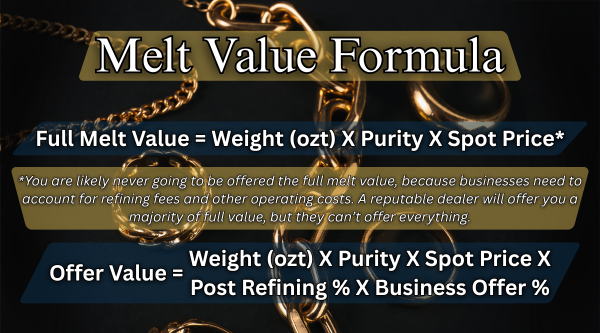
Because 14k white gold and 14k yellow gold yield the exact same fine gold inside a refining crucible, their cash payout is identical.
Color plays zero role in the melt equation.
The Myth of Rhodium Plating Resale Value
Sellers often wonder if the rare rhodium coating on white gold adds extra value during liquidation.
The reality is that rhodium electroplating is microscopically thin, typically between 0.5 and 1.0 microns deep. That layer is significantly thinner than a human hair or a strand of spider silk.
In an industrial smelting furnace, this trace amount of rhodium vaporizes or dilutes completely into the slag.
It is economically impossible to extract or isolate micro-grams of rhodium plating from individual scrap jewelry pieces. Therefore, gold buyers assign zero financial value to rhodium plating on used items.
You pay for rhodium at retail, but you cannot cash it out at resale.
Why Refineries Don’t Pay Premiums for White Alloys
Sellers sometimes argue that white gold made with palladium alloys should earn a higher cash payout.
While raw palladium is valuable, refiners actually charge processing fees to separate non-gold alloy metals out during refining. Isolating nickel, copper, or palladium from molten scrap gold consumes energy, labor, and chemical reagents.
The secondary market prices scrap strictly based on how much gold can actually be recovered.

A Lesson in Chemical Assay Testing
A seller once arrived convinced his white gold chain was worth extra cash because of its original high-end jeweler tag.
He argued that the white alloy formulation made the chain inherently superior to standard yellow gold scrap. To demonstrate how gold purity actually works, we walked him through a live acid assay test right at the counter.
We rubbed the chain against a black slate to leave a tiny metal streak, then dropped 14k nitric acid test solution onto the mark.
The streak held firm without dissolving or turning brown, proving the piece held its true 58.3% gold purity, no more, no less. Seeing the acid react directly on the touchstone showed him that precious metal testing relies on hard chemistry, completely blind to metal color or retail tags.
He walked away with a fair cash payout and a clear understanding of hard asset valuation.
The Bigger Picture: Markup Pricing vs. Hard Metal Value
Retail Jewelry Markups vs. Sound Money Investment
Wearable luxury jewelry and physical bullion investment operate on completely different economic principles.
Retail jewelry items frequently carry markups ranging from 300% to over 1,000% above the underlying spot price of the raw metal. These massive markups cover retail lease costs, marketing campaigns, designer branding, and showroom sales commissions.
| Price Component | Estimated Value | Notes |
| Raw Gold Melt Value | $400 | Intrinsic fine gold content |
| Manufacturing & Rhodium | +$100 | Labor, alloying, and electroplating |
| Retail Showroom Markup | +$1,000 | Overhead, branding, sales margin |
| Total Retail Price | $1,500 | What you pay at the store |
| Real Resale Payout | $260 – $300 | What a secondary buyer pays |
Confusing retail price tags with true intrinsic value leaves buyers vulnerable to overpaying for decorative items.
When buying precious metals for wealth preservation, stick to pure bullion bars and sovereign coins. If you buy jewelry, buy it because you love wearing it, not under the false impression that white gold acts as a superior store of value.
Knowing the difference between retail luxury and hard metal value keeps your money protected.
Secondary Market Transparency
Working with an established precious metals recycler removes the illusions created by retail showroom price tags.
Reputable buyers base every offer directly on live market spot prices, objective weights, and verified karat purities. This means you receive the true market value when liquidating scrap items.
When you strip away the retail markup, gold is simply gold.
Frequently Asked Questions
Is 18k white gold worth more than 14k yellow gold?
Yes. An 18k piece (whether white or yellow) contains 75.0% pure fine gold, whereas a 14k piece contains 58.3% pure gold.
The karat rating dictates the pure gold percentage, which directly determines the cash melt value regardless of metal color.
Does rhodium plating wear off over time?
Yes. Rhodium electroplating naturally wears away after two to five years of regular daily wear.
As the micro-coating thins, the faint yellowish white gold alloy underneath becomes visible. Re-plating a ring at a retail jeweler typically costs fifty to one hundred dollars or more, adding to white gold’s ongoing cost of ownership.
Can you melt white gold and yellow gold together?
Yes. Commercial precious metal refineries regularly melt white, yellow, and rose gold together inside the same high-temperature crucible.
Chemical refining processes isolate pure 24k fine gold from all alloyed base metals, regardless of their original color.
Will a gold buyer pay less if white gold rhodium plating is worn off?
No. Professional gold buyers analyze precious metal purity using touchstone acid assays or chemical testing.
Surface wear, scratches, or faded rhodium coatings have zero impact on the final scrap cash payout.
Real Value Beyond the Showroom
White gold costs more upfront at retail counters because you are paying for complex alloy formulations, extra labor, and rare rhodium electroplating.
When it comes time to sell, white gold and yellow gold stand on equal ground. Cash payouts are calculated strictly using precise weight, verified karat purity, and live market spot prices.