
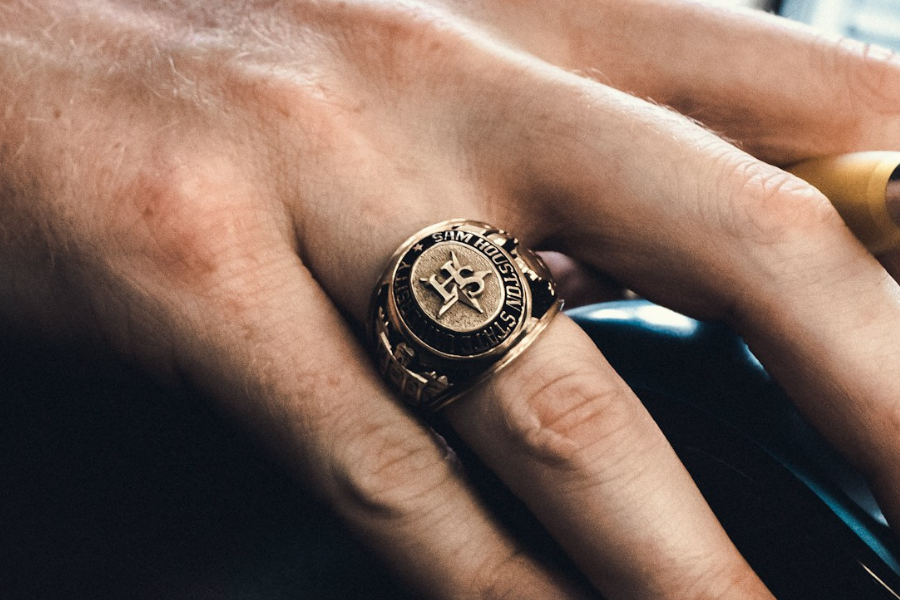
That heavy class ring from your high school or college graduation is likely just gathering dust.
It has probably sat at the bottom of a drawer, completely unworn, for decades. If you have no emotional attachment to it, that ring is just frozen cash waiting to be used. But to get that money, you have to look past what you originally paid for it.
The secondary market only cares about the raw metal that can be melted down.
What This Guide Will Show You
We are going to break down exactly how to find your ring’s true scrap value.
You will learn how to read the tiny, hidden stamps inside the band to identify the metal. We will show you how to weigh the ring and calculate its real-world class ring melt value. This ensures you can confidently sell old class rings for cash without getting ripped off by bad buyers.
By the end of this article, you will know exactly what your class ring is worth today.
The Retail Premium vs. Scrap Value Reality Check
There is a huge gap between what a ring costs brand new and what a dealer pays.
A new ring can easily cost anywhere from $500 to $900 when bought through a school. Most people assume that high price tag means the ring is packed with valuable gold or silver. In reality, that upfront cost is mostly made up of massive corporate retail markups and manufacturing fees.
The initial price tag has very little to do with the actual value of the metal.
Why Are Class Rings So Expensive Retail?
The high retail price is driven by a lot of upfront costs you can never recover.
First, manufacturers have to set up custom molds for every specific school name and graduation year. Second, big companies like Jostens, Balfour, and Herff Jones pay high licensing fees to sell inside schools. Finally, a large chunk of what you pay goes directly toward commissions for the sales representatives.
You are essentially paying for the custom factory setup, school contracts, and corporate sales commissions.
The Reality of the Secondary Market
The moment you graduate, the value of that custom design drops to exactly zero.
A precious metals dealer does not care about your school mascot, your initials, or your graduation year. The secondary market runs strictly on the physical supply and demand of raw gold, silver, or palladium. A recycler only cares about the actual weight of the metal they can melt down in a crucible.
When you look for the gold class ring scrap value, the custom artwork is completely taken out.
The Shock of the Counter Offer
Many people experience complete sticker shock when they try to get a cash offer for their ring.
Someone might bring in a heavy, chunky ring they bought back in 1998 for around $750. They expect a solid payout, only to find out the ring is made of a base metal blend. The dealer has to explain that the item carries absolutely no precious metal scrap value at all.
It can be disappointing to hear, but a dealer can only pay for the actual precious metal content.
The Flip Side of Old School Gold
On the other hand, people with older gold rings often get a great surprise.
An older graduate might bring in a battered 10k gold class ring weight in grams from 1982. They assume it is worthless because it looks old and scratched up from years of sitting around. Instead, they walk out with hundreds of dollars because gold prices have climbed so much over the years.
If your ring has real gold in it, those rising market prices work heavily in your favor.

The Master Metal Stamp Reference Table
To clear up any confusion, you can check the exact contents of your ring using this master breakdown.
The table below separates trademarked base metals from genuine silver, palladium, and gold alloys. Each row shows the specific stamp, whether it holds precious metal value, and the exact elemental percentages inside. Use this data to cross-reference the microscopic hallmark struck inside your band before selling.
This structural data completely removes the guesswork from evaluating your ring’s material purity.
| Metal Name | Inside Band Stamp | Precious Metal? | Gold % | Silver % | Palladium % | Other Metal % |
| Lustrium | LTM | No | 0% | 0% | 0% | 100% |
| Lazon | LZN | No | 0% | 0% | 0% | 100% |
| Siladium | S (in a circle) | No | 0% | 0% | 0% | 100% |
| Valadium | VAL | No | 0% | 0% | 0% | 100% |
| Celestrium | CELE | No | 0% | 0% | 0% | 100% |
| Palladium Plus | PD PLUS | Yes | 0% | 65% | 24% |
11% (Copper/Base)
|
| Q-Pal | Q-PAL | Yes | 2% | 61% | 25% |
12% (Copper/Base)
|
| Precium | PRECIUM | Yes | 0% | 63% | 24% |
13% (Copper/Base)
|
| Argentum | ARGENTUM | Yes | 25% | 10% | 11% |
54% (Copper/Base)
|
| Argentus | ARGENTUS | Yes | 0% | 74% | 10% |
16% (Copper/Base)
|
| 10K Gold | 10K / .417 | Yes | 41.70% | 0% | 0% |
58.3% (Copper/Nickel)
|
| 14K Gold | 14K / .585 | Yes | 58.50% | 0% | 0% |
41.5% (Copper/Nickel)
|
How to Use This Data
You should use your phone camera to zoom in close on the inner band stamp.
Match whatever letters or numbers you find directly with the stamps listed in the table above. If your hallmark lands in the bottom sections, you are holding real, tangible precious metal weight. If it lands at the top, you have an industrial base metal meant purely for durability.
Knowing these exact alloy percentages protects you from bad buyers and uneducated secondary market offers.
The Truth About the Gemstones
That large, colorful center stone in your graduation ring is a major source of pricing confusion.
Many people are told that their ring features a real gemstone like a ruby, emerald, or sapphire. While it is true that manufacturers often used genuine semi-precious stones, their secondary market value is essentially non-existent. These are commercial-grade stones produced in massive quantities, which means they do not carry any resale value. (Only natural diamonds are considered to have a meaningful secondary market value.)
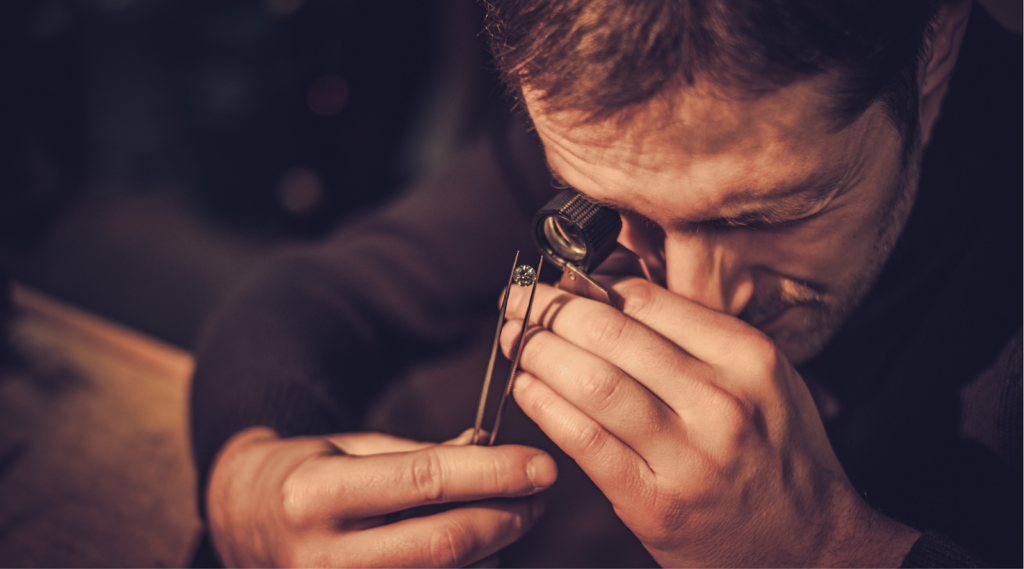
When you bring the item to a dealer, the stone is treated as a zero-value asset. In fact, dealers need to account for the weight of that gemstone so they can deduct it from the full weight of the ring, leaving them with just the weight of the metal with real value.
How to Estimate Your Ring’s Cash Value at Home
You can easily estimate your item’s baseline value right on your kitchen counter.
First, identify the exact metal type from our reference table and weigh the ring in grams on a scale. Next, subtract a standard buffer for the stone and multiply the remaining weight by the metal purity percentage. Finally, multiply that pure weight by the day’s current spot price for gold, silver, or palladium.
This simple math gives you an estimated full raw value before you ever speak to a buyer.
Understanding the Dealer Offer Gap
You must realize that no local business can pay you one hundred percent of that spot price.
Precious metal dealers have to pay significant fees to melt and process the scrap metal at a refinery. They also take on market risk by holding physical inventory while global precious metals prices constantly bounce around. A reputable shop has to factor in these operational expenses and basic business costs to stay open.
The final cash offer will be a fair percentage of your total calculated raw melt value.
Turn Your Stagnant Dust Into Real Assets
Your old graduation ring served its original purpose as a great milestone marker years ago.
If it has spent the last decade completely unseen and untouched, it is no longer a sentimental keepsake. It has slowly morphed into a stagnant financial asset that is trapped inside your home junk drawer. You can intentionally choose to convert that frozen metal into immediate, liquid cash for your current needs.
Turning dead weight into moving cash is simply a smart, practical reallocation of your personal wealth.
Transparent Valuation for Minnesota Locals
If you live in Minnesota, you can get a transparent face-to-face evaluation today.
You can stop by any of our local offices located in Woodbury, Maple Grove, Bloomington, or Duluth. There is absolutely no appointment necessary, so you can walk right in whenever your schedule allows. Our non-commissioned experts will test your ring’s metal purity and weigh the item right in front of you.
You will walk out with a secure business check and zero high-pressure sales tactics.
Secure Mail-In Options for Nationwide Sellers
If you live outside of Minnesota, you can still access the exact same transparent pricing.
You can easily request our free online mail-in kit directly from our website to start the process. This specialized kit allows you to safely and securely ship your unwanted jewelry items directly to our team. Once received, our evaluation experts will perform a fast, clean, and completely transparent valuation of your metal.
It is the easiest way to safely sell old class rings for cash from anywhere.
Common Questions About Class Ring Purity and Value
Can I sell my class ring back to Jostens or Balfour?
The short answer is no, you cannot sell your old item back to the initial manufacturer.
Retail jewelry companies are solely set up for forward manufacturing and selling high-margin products to students. They simply do not operate consumer buy-back programs or handle secondary market scrap metal recycling for individuals. If you want to turn your unwanted graduation jewelry into liquid cash, you must bypass them entirely.
You need to take your item to a dedicated precious metals dealer or a specialized refinery buyer.
Are class ring diamonds real?
In the vast majority of standard high school jewelry pieces, the clear accent stones are completely artificial.
Manufacturers typically use low-cost cubic zirconia or synthetic white sapphire to mimic the look of real diamonds. However, some high-end championship items or premium university rings do occasionally feature small, genuine precious diamond stones. A professional gold buyer can verify this instantly by using a handheld thermal conductivity tester on the spot.
If the stones happen to be real, a reputable shop will add an extra cash premium to your payout.
Is a class ring marked LTM worth anything?
If you see the letters LTM stamped inside your jewelry band, it carries zero precious metal scrap value.
The letters stand for Lustrium, which is a proprietary nickel-chromium base metal alloy trademarked by the Jostens company. While it looks remarkably similar to white gold or sterling silver, it contains absolutely no actual precious elements. Because it lacks gold or palladium, industrial refiners cannot economically recycle the metal for a secondary market payout.
It is a durable material for daily wear but holds no value at a precious metals shop.
How much cash can you get for a ten karat class ring?
The exact cash payout you receive depends entirely on the total weight of the clean gold alloy.
A typical men’s graduation ring can weigh anywhere from fifteen to twenty-five grams on a digital scale. Since ten karat gold is exactly forty-one point seven percent pure, you only get paid for that specific portion. The dealer will weigh the piece, calculate the pure gold content, and apply the current daily spot market price.
An average piece can easily net you mid double digits to mid triple digits today depending on the exact weight and purity.
